


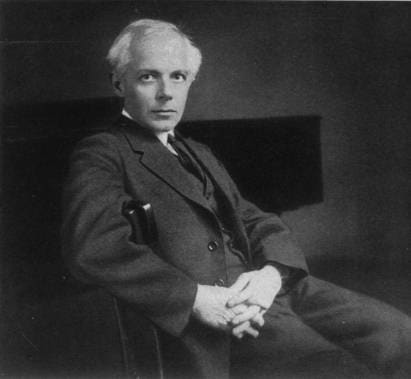
Béla Bartók is one of the most influential composers of the 20th century and at the same time an outstanding ethnomusicologist. Together with Zoltán Kodály he travelled the Hungarian, Romanian, and Slovak villages with a phonograph, recording thousands of authentic folk melodies that became the basis of his innovative style.
Bartók fused an archaic folk melos with the boldest achievements of modernism — sharp harmony, complex rhythm, a percussive treatment of the piano. His masterpieces are “Music for Strings, Percussion and Celesta,” the cycle “Mikrokosmos,” six string quartets, concertos, and the opera “Bluebeard's Castle.” He spent the last years of his life in emigration in the USA. Bartók is an example of how deep roots in a folk tradition can become the ground for the most advanced, universal art; his path is in many ways akin to that of the Ukrainian national school.